I’m typically not a big fan of the “comedy roast” genre. I have a very sensitive cringe tolerance level that makes me want to turn the channel immediately. But hey, if consenting adults want to make the choice to go on television to voluntarily engage in public humiliation, more power to them. I will say I thoroughly enjoyed the roast of James Franco a few years back. I think that one worked because you could tell many of the participants were actual friends. Too many other times, you get the sense that roasters and roastees hardly know one another which makes it feel meaner spirited.
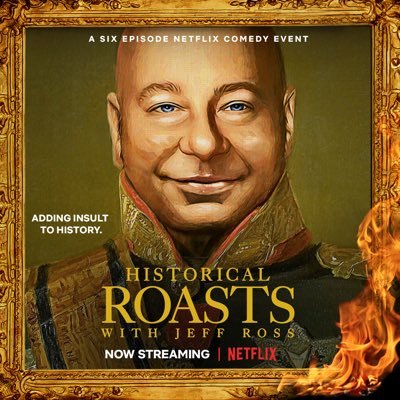
Historical Roasts with Jeff Ross found a way to circumvent much of the cringe by focusing the verbal venom on well-known historical figures instead of modern celebrities.
After warming up the audience with some Civil War dysentery poop jokes, the show falls into the familiar roast format. Ross introduces Lincoln (Bob Sagat) and intersperses sick burns with biographical material that chronicles the prevalent amount of death in Lincoln’s family tree. Mary Todd Lincoln (Natasha Leggero) hurls insults at her husband while chugging booze and snorting crushed up Xanax. Harriet Tubman (Yamaneika Saunders) embraces an angry, hypersexual tone that contrasts with the usual stoic textbook image. Tubman takes Lincoln to task for not issuing the Emancipation Proclamation earlier in the war and for advocating the colonization of former slaves on the African continent. Frederick Douglass (Jerron Horton) chimes in that Lincoln allowed unequal pay for Black soldiers. Lastly, John Wilkes Booth (John Stamos) gives an over-the-top portrayal of a self-absorbed actor that includes a musical number.
I can’t vouch for the other five episodes, but so far, I find the show’s premise very intriguing. There are plenty of roast fans that may not be full history heads that could tune into this show and perhaps learn something new. The show’s light on history, heavy on vulgarity, but self-aware of its own absurdity. For some hot button topics, the comedic and historic premise of the show could even be psychologically cathartic.
While historians and biographers can write volumes of books on an individual, no one can say for certain that they definitively know their subject’s personality and motivations. Much is left to conjecture and context clues. Scholars try their best to get at a historical figure’s essence, but their interpretations are always filtered through the lens of their own personal experiences. If we squint really hard, we can see Ross and company unapologetically embracing this inherent subjectivity in history with a wild abandon. It’d be easy for historians to turn their nose up at the show, but on some level, they’d be hypocritical for doing so.
 History Heads